Anandale
Mariners' Museum, Uncurated Search Results
Type: Schooner
Year: 1919
Builder: Eastern Shore Shpbldg. Thirty-Six Corp.
Location: Sharptown

These records are found in the online catalog of The Mariners’ Museum and Park in Newport News, Virginia. Uncurated search results are presented to give researchers and interested readers an idea of whether the museum’s archives contain information about this vessel and whether it may be worthwhile to visit the museum’s catalog search page for further investigation. Uncurated results may be inaccurate or incomplete.
Search mode: Exact Name. Search phrase(s): "Anandale". Results returned: 2. Results displayed in this table: 2.
Use these buttons to send uncurated search results to your own app or text document for further research. First, check the box for any row, or click "Select All" then uncheck any rows. Then click "Show Selections". You can then copy your selections from the text box and past them into your app.
| Fetch? | Row ID | Media | Date | Vessel | Place | Related Places | Inscription/Marks | Subject | Notes | Archive Number |
|---|---|---|---|---|---|---|---|---|---|---|
| 1 | No image URL. | Anandale | P0001.011/01-0185 | |||||||
| 2 | 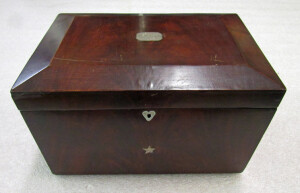 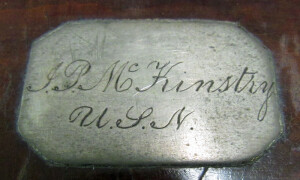 | SHORT DESCRIPTION: Ditty box of mahogany veneer, highly polished with beveled lid. Lid has metal octagonal plate with owners name "J. P. McKinstry, U.S.N.". Front panel has heart shaped escutcheon and metal star at lower center third of panel. Blue felt base. ADDITIONAL INFORMATION: James Paterson McKinstry (New York) (February 9, 1807- February 11, 1873) [From The Records of Living Officers of the U.S. Navy and Marine Corps, By Lewis Randolph Hamersly] • Appointed from Michigan, February 1, 1826; • Navy Yard, Boston, 1827; • Sloop Warren (1827), Mediterranean Squadron, 1829-1931; western Mediterranean guarding American commerce from Greek piracy during the Greek War of Independence [see Joseph Partridge watercolors]; ship returned to the United States in the summer of 1830, arriving at Norfolk, Virginia, on 30 August. Decommissioned for repairs, on 10 September, Warren was recommissioned on 2 September 1831, Master Commandant Benjamin Cooper in command, for service on the Brazil Station. • Promoted to Passed Midshipman, April 28, 1832; • Passed Midshipman, awaiting orders, Navy Yard, New York, 1833-1834. • Schooner Experiment (1832); built in 1831 by the Washington Navy Yard; and sailed for tests in Chesapeake Bay in April 1832. Until the middle of 1833, Experiment cruised the Atlantic coast between Boston, Massachusetts, and Charleston, South Carolina. After repairs at Norfolk, she sailed for the West Indies, returning to New York in June 1835. During the remaining three years of her cruising service, she was often used for surveying. • Commissioned as Lieutenant, February 9, 1837; • Sloop Concord (1828), West India Squadron, 1837; • Schooner Dolphin (1836), Brazil Squadron, 1840; Dolphin made two cruises off the coast of Africa to suppress the slave trade from 18 December 1839 – 14 July 1840 and again from 5 November 1840 – 25 May 1841. On 7 September, she sailed to join the newly organized Home Squadron cruising on the Atlantic coast and in the West Indies. Aside from a repair period at New York from 31 December 1841 – 4 March 1842, she served with the Home Squadron until October 1843. • Sloop Falmouth (1827), Home Squadron, 1843; Falmouth cruised from the Banks of Newfoundland to the mouth of the Amazon and in the Caribbean and Gulf of Mexico with the Home squadron until 1846, aside from necessary repair periods. She operated chiefly in the Gulf of Mexico, carrying messages and Government officials, convoying Army transports to Texas, and protecting American interests in Mexico. • Steamer Michigan (1843), on the Lakes, 1845-1847; (still Lieutenant) • Sloop St. Mary's (1844), Pacific Squadron, 1847; Mexican-American War: in January 1847, St. Mary’s proceeded to Lobos to cover the movement of General Winfield Scott's troops. In early March, she escorted the transports into the Antón Lizardo anchorage. On the 8th, she moved toward Vera Cruz; and, on the 9th, her boats carried assault troops to Collado Beach, where Scott's force was landed, without resistance, in under five hours. St. Mary's remained in the area through the end of the month to support the siege of the city. On the 22nd, one of her 8-inch guns, along with guns from other ships, was ferried ashore and placed on a ridge near Fort Santa Barbara to augment the Army's artillery. The bombardment of the city began the same day. On the 29th, the city was formally surrendered. St. Mary's then retired to Antón Lizardo, whence she sailed toward Alvarado to assist in the taking of that town. By the time she arrived, however, the town had fallen; and she resumed blockade duties. On 10 April, she had been ordered back to the United States by the Secretary of the Navy; and, in early May, she sailed for Norfolk, Virginia, carrying captured Mexican guns as cargo. The sloop remained at Norfolk for almost a year. On 11 April 1848, she sailed for duty with the Pacific Squadron; and, for the next five years, she cruised from the coast of California to the coast of Chile, in the Central Pacific, and in the Far East. • Rendezvous, Boston, 1850; • Commanding mail steamer Georgia (1848), 1854-1855; a civilian mail steamer under contract with the Navy. New York to Chagres service from January 28, 1850 until February 1854. The Georgia was partially wrecked in a gale on February 6, 1854. o Lt. McKinstry was in command of the vessel. o During the gale a wave carried away the bowsprit, forecastle, and stove in about thirty feet of the bows on each side, down flush with the second deck. Each dip of the ship’s head allowed tons of water into the vessel. McKinstry ordered steam pumps to be employed and moved the passengers after to raise the head of the vessel. McKinstry and officers and crew cleared the wreckage at the risk of being washed overboard and rigged a temporary stay for the foremast. They constructed a bulkhead of mattresses, canvas and timber to keep the water out. o Capt. McKinstry had to quell and attempt by some of the male passengers and crew to take possession of and launch the small boats in an attempt to save themselves. o Bailing gangs were formed and within several hours the water level had dropped and no longer threatened the boilers/engines. o McKinstry changed course for Norfolk, Virginia. o Georgia was laid up in New York from 1854 to 1859, and subsequently condemned. (The passengers reported the vessel was quite rotten.) • Commissioned as Commander, September 14, 1855; • Light-House Inspector, 1858-1859 o Inspector 27 Aug 1857 - 2 Oct 1858 o Acting Engineer 9 Mar 1858 - 15 Mar 1858 • Commanding steam-sloop Dacotah, Blockading Squadron, July 22, 1861. o Dacotah in East Indies Squadron March 4, 1861. o August 6, 1861 -December 16, 1861 sailed from Hong Kong to New York o Pilot H.A. Anandale took passage on Dacotah (McKinstry in command) and piloted the vessel from St. Pierre (on morning of November 24th), Martinique to Basse Terre and Point à Pitre, Guadeloupe, and thence to St. Eustatius and St. Batholomew, and then to St. Thomas (arrived November 30th). Reported leaving for Boston on December 1st, 1861 by Captain James Glynn of USS Macedonian. o Cruising on coast of Cuba between Havana, Bahia Honda, and Tortugas. o Apparently left port November 19th towing the schooner E. J. Talbot, which was carrying coal and provisions for the Iroquois at St. Pierre (Iroquois was on duty watching for Sumter). The following day the Dacotah changed course to chase a bark thought to be Sumter, the ship fired a blank cartridge to windward and overtook the vessel only to discover it was the H.B.M. bark Terror. o Ordered March 1, 1862 to search for USS Vermont which had been damaged during a gale. o Arrived at Hampton Roads March 13, 1862. June 27, 1862 still in Hampton Roads and communicating with Capt. Thomas of the Army regarding a convoy of transports. o June 28, 1862 off Jamestown Island. o July 24, 1862 reported in James River forming independent division of the North Atlantic Blockading Squadron o August 23, 1862 off Jordan’s Point in James River o Ordered September 4, 1862 to proceed with USS Minnesota to Nassau to assist in search from CSS Alabama and CSS Florida. o Ordered October 24, 1862 to coasts of Nova Scotia and New Foundland to search for Alabama and recover the health of the crew (many of which were suffering from Yellow Fever). o November 17, 1862 in New York • Commissioned as Captain, July 16, 1862; • Commanding steam sloop Monongahela, Western Gulf Blockading Squadron; present at Port Hudson and Vicksburg, 1863. While in command of the Monongahela, operating on the Mississippi, Captain McKinstry was wounded, and during the remainder of the war was compelled to remain inactive; o Monongahela was built by the Philadelphia Navy Yard and was launched on 10 July 1862; and commissioned on 15 January 1863, Captain James P. McKinstry in command. Initially assigned to the North Atlantic Squadron, Monongahela sailed instead to reinforce Rear Admiral David G. Farragut's West Gulf Blockading Squadron off Mobile, Alabama, remaining on duty off that port until ordered to attempt to run past Confederate batteries on the Mississippi River at Port Hudson, Louisiana on the night of 14-15 March 1863. As Army forces ashore conducted a mortar bombardment, the squadron got underway about 22:00, heavier ships Hartford, Richmond, and Monongahela screening the smaller Albatross, Genesee, and Kineo from the forts, with steam frigate Mississippi bringing up the rear. In the course of the ensuing furious engagement, only Hartford and Albatross succeeded in passing up river, Richmond losing her steam power early in the battle and drifting downstream out of range with Genesee lashed alongside. Monongahela grounded under the guns of a heavy battery, taking a pounding and losing six men killed and 21 wounded, including the captain, until she worked loose with Kineo's aid. While attempting to continue upriver, her overloaded engine broke down, and the sloop was forced to drift downstream with Kineo. • Commanding receiving ship North Carolina, New York, 1865-1866. (found an alternate source that says he was commanding the USS New York) • Chattanooga, a screw steamer, launched 13 October 1864 by William Cramp & Sons, Philadelphia, Pa.; completed by the Philadelphia Navy Yard and commissioned 16 May 1866, Captain J. P. McKinstry in command. After final trials in August 1866, Chattanooga returned to the Navy Yard where she was decommissioned 3 September 1866. • Commissioned as Commodore, July 25, 1866; • Commandant Naval Station, Sackett's Harbor, New York, 1867-1869. • 1869 Commodore (active) o Lighthouse Inspector 9 Oct 1869 - 1 Oct 1870 • 1872 Commodore (retired) • Died, February 11, 1873. 39 years 11 months service as of 1866 US Navy papers including naval appointments are at the Bentley Historical Library at the University of Michigan (Flora Burt Family Papers: circa 1830s-1860s; Box 3) | CL1544 |
Created 2026 by Don Barker, CBMM volunteer, for the Chesapeake Shipbuilding Project. shipbuilding@sailingworkboats.es